
WOULEY · Materials & craftsmanship

Bilinga veneer, golden tones and natural grain. Photo: Philipp Zinger / Wikimedia Commons — CC BY-SA 4.0 .
If Padouk is fire, Bilinga is gold. This great wood from equatorial Africa reveals a golden-yellow heart with a subtle shimmering grain that catches the light like a precious metal. But its beauty is only part of its story: Bilinga ranks among the continent's most enduring woods, and for centuries its tree was one people turned to for healing. At WOULEY, where wood is our primary material and Africa our point of reference, Bilinga holds a special place.


01
A giant of the equatorial forests
Bilinga refers to the botanical species Nauclea diderrichii, a member of the Rubiaceae family — the same family as the coffee plant. It is a giant of Africa's humid forests, found from Sierra Leone to Uganda and across Cameroon, Gabon, Congo, Côte d'Ivoire and Nigeria. Its straight, cylindrical trunk can rise twenty to thirty meters without branches before reaching the canopy, with the tree sometimes growing up to fifty meters tall.
Few trees have been given so many names by so many peoples. It is known as akondok in Cameroon, badi in Côte d'Ivoire, aloma in Gabon, kusia in Ghana, opepe in Nigeria and n'gulu-maza in Congo. This abundance of names says something simple: wherever Bilinga grows, it has mattered.
02
The tree of a hundred names: the wood that healed
Follow, for a moment, the path of a healer at dawn through the humid forest of the Congo Basin. He stops at the foot of a great Bilinga tree. It is not the wood he has come for, but its bark — grey, deeply fissured and intensely bitter.
Before becoming an exceptional timber, Bilinga was, for countless African peoples, a medicinal tree. From Côte d'Ivoire to Congo, from Cameroon to Gabon, traditional healers prepared decoctions from its bark, reputed to soothe fever and everyday ailments. Among the Mbuti of the Ituri Forest, it was known as madamu; elsewhere, it was sometimes called the “African peach”, as its fruit is edible.
Where other woods offered themselves to the eye, Bilinga offered itself to healing.
This connection with healing is not entirely surprising: Bilinga belongs to the same large botanical family as coffee and cinchona — plants from which humanity has drawn both remedies and rituals of awakening. There is something in this wood of an ancient alliance between people and the forest: a tree that nourishes, that heals and that, once mature, provides one of the continent's most robust timbers.
By working with it today, we are not simply shaping a beautiful golden material. We are continuing the gesture of all those who, before us, recognized an ally in this tree.
03
An exceptional character
Behind its golden glow, Bilinga is a wood with character, made to last.
First and foremost, it is a dense and heavy wood with uncommon strength. Resistant to compression, bending and abrasion, it ranks among the most dependable African woods for demanding applications — traditionally chosen for structures where failure is simply not an option.
Its defining quality, however, is its durability. Naturally highly resistant to fungi, termites and insects, Bilinga goes further than many woods: it withstands prolonged contact with water, including marine environments. It is one of the woods capable of taking on demanding harbour and hydraulic structures — an endurance that commands respect.
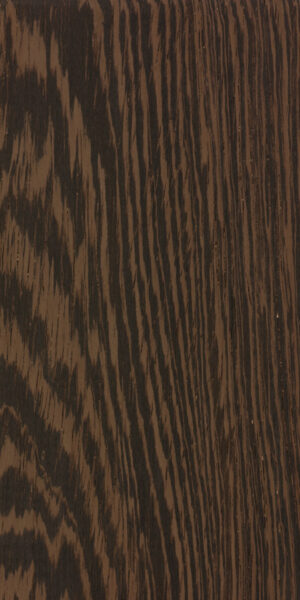
Then comes its distinctive beauty. Its heartwood ranges from golden yellow to yellow-orange, animated by a subtle shimmer that changes with the angle of the light. Its pronounced interlocked grain can produce ribbon-like reflections on certain cuts, a quality highly prized in fine veneers. Indoors and away from direct sunlight, its color remains remarkably stable; with exposure to light, it gradually deepens toward amber and rich honey tones, gaining character as its initial brightness softens.

Bilinga's interlocked grain and ribbon-like reflections. Photo: Rasbak / Wikimedia Commons — CC BY-SA 3.0 .

04
The art of showcasing it
Strength, stability and golden light: Bilinga lends itself to a wide variety of uses.
Indoors, its warm tone and subtle shimmer make it a refined choice for furniture and decoration: trays, tables, lighting and objects where the natural gold of the wood speaks for itself. Its ribbon-like grain is particularly sought after in veneer, bringing warmth and depth to furniture and decorative panels.
Outdoors, its exceptional resistance makes it a premium wood for decking, cladding and exposed joinery — where many species reach their limits, Bilinga endures.
Its reputation was also forged on some of the most demanding worksites: bridges, harbour structures, industrial flooring and constructions in contact with water. A wood that has proven itself where performance matters most.
At WOULEY, Bilinga naturally finds its place in our lighting, corporate gifts, furniture and decorative collections.
05
Caring for its beauty
Bilinga requires little maintenance — above all, it gives you a choice: preserve its golden color or embrace its natural patina.
- To preserve its golden-yellow color: keep it away from direct sunlight and occasionally apply an oil or varnish with UV protection. This will help preserve its original color for longer.
- To embrace its natural patina: let the light do its work. The golden tones will gradually deepen toward amber and honey, and outdoors eventually develop an elegant silvery-grey appearance.
- For everyday care: a soft, slightly damp cloth is generally sufficient indoors. Avoid aggressive cleaning products.
- Outdoors: thanks to its natural durability, it requires no preservative treatment. Occasional cleaning and a nourishing oil can restore its warmth if you prefer not to let it weather naturally.
06
Bilinga at WOULEY
Choosing Bilinga means bringing together in a single piece the strength of a great structural wood and the memory of a tree that, for generations, watched over people. This is exactly what drives us: turning each object into a bridge between contemporary craftsmanship — CNC machining and laser work — and the richness of our continent's wood species. As with all our woods, we favor responsible sourcing so that the beauty of Bilinga never comes at the expense of the forest in which it grew.